Mahaweli Maha Seya by Wikipaedia, Premasara Epasinghe etc

Mahaweli Maha Seya (Wikipaedia)
The stupa came from an idea by the former Minister of Mahaweli Development, Gamini Dissanayake.
The stupa was built in commemoration of over 50 submerged temples and the people who lost their properties as a consequence of the Mahaweli Development programme in the early 1980s. The Mahaweli Development Project was the largest development project conducted in Sri Lanka after the country obtained independence.
The foundation stone was laid by President J. R. Jayewardene on 20 March 1983. The work was completed and the stupa was opened by President Maithripala Sirisena and Prime Minister Ranil Wickramasinghe on 20 June 2016.
The stupa is 88 m (289 ft) tall, making it the second-largest stupa in Sri Lanka, second to Ruwanweli Maha Seya in Anuradhapura, built in 140 BC. Its structure was designed by Vidya-Jyothi Dr. A.N.S. Kulasinghe.
Daily News, 24 January 2003
Resumption of Kotmale Mahaweli Maha Seya construction work
by Premasara Epasinghe, Media Consultant, Ministry of Irrigation and Water Management
The construction work of Kotmale Mahaweli Maha Seya (stupa) which was in abeyance for quite sometime has now been re-commenced with the dawn of the New Year 2003.
Minister of Irrigation and Water Management, Gamini Jayawickrama Perera has initiated a series of religious activities including all night pirith chanting and the offering of alms to Maha Sangha in the premises of the Sacred Bodhi Tree at Anuradhapura. These religious rituals are being held to invoke blessings on the resumed Maha Seya construction work and on all those including the Minister who have dedicated themselves to this sacred duty. Further it is in effect a New Year blessing.
Kotmale Valley has from very early days on, been a prosperous settlement. Over and above this, the valley is picturesque and alluring, nestling 5500 feet above sea level.
The ancient chronicles of Sri Lanka associate this region with the heroic monarch of this land King Dutugemunu. The chronicles describe with marked relish, how, young Prince Gamini spent his youth in Kotmale Valley. There is a view that states, that Prince Gamini came over to this region to acquire weapons for his planned military campaign.
This implies that various minerals and metals existed in this area. Metal workers of great skill practised their crafts in Kotmale region at that time. Even today, there are artisans excelling in the making of iron and steel products. Whatever that may be, in ancient times, as much as today, the main economic pursuit of the people was paddy cultivation. When we delve into the history of this area, Kotmale is referred to, for the first time in the Sinhala classic Pujavaliya. The name Kotmale is given as Kotthumala.
According to chronicles, the Tooth Relic that had been concealed in Kotmale was taken to Dambadeniya in the reign of King Vijayabahu the third (1232-1236). Kotmale is referred to in the narration of the reigns of King Wickramabahu the third (1357-1374) and Rajasinghe the first.
Today the valley of Kotmale assumes a special significance, because of the Great Reservoir that has been constructed there. The reservoir which is part of the accelerated Mahaweli Development Project, is the artificial tank built at the highest sea level, in this country.
It could be considered a gesture of destiny, Gamini Dissanayake the pioneer in the implementation of the Mahaweli Development Project should construct the Kotmale Reservoir in the Kotmale Valley where he himself was born. He was prompted to allow the villages and lands in which he grew up and roamed about as a child to be inundated by such a massive reservoir, undoubtedly because he fully and far-sightedly realised the tremendous benefit the reservoir will render to the People of the land
The state has decided to name the Kotmale Reservoir, after Gamini Dissanayake as tribute and in memory of this great personality.
Kotmale Reservoir that came into being due to the active national service of Gamini Dissanayake, provides water to dry zone. In addition, it supplies power to the whole island. This way, Kotmale Reservoir performs a crucial service to this country. Thousands of people lost their homes and lands because of this project. Hundreds of religious edifices also went under water. Their cultural heritage and sacred cities suffered the same fate.
Gamini Dissanayake took steps to compensate these people and to re-settle them in lower and upper Kotmale Valley Regions.
Gamini Dissanayake felt the need to make amends for the cultural heritage and the sacred sites that went under water. As a symbol of heritage people lost, he decided to construct Kotmale Mahaweli Maha Seya in the village of Kadadora. Historically it is interesting to note that in the Kotmale valley frequented by Prince Gamini, a modern Gamini should plan to construct a Maha Seya. The intention of Gamini Dissanayake was to set up Mahaweli Maha Seya to mark the completion of the victorious Mahaweli Project.
With due deference to the great King Gemunu it was decided by Gamini Dissanayake his Maha Seya a single foot less in height than the great Ruwanveli Seya.
Unfortunately just as King Gemunu did not live to see the completion of his beloved Ruwanweli Seya, Gamini Dissanayake too could not see the completion of his beloved Kotmale Mahaseya. The honourable task of completing Kotmale Mahaseya has now devolved upon yet another Gamini. That is Gamini Jayawickrama Perera.
Mahaweli Maha Seya Project is the first construction of this magnitude ever to be undertaken by C.E.C.B as a Design and Built Project by employing direct labour.
The Mahaweli Maha Seya envisages the construction of 61m diameter, 280mm thick Shell-type Dome on 32 nos. bored pile foundation of 1m diameter, Square Chamber, God's Chamber, Spire and Pinnacle forming a Dagaba of total height 88m at an estimated cost of 140 million rupees in 1989.
The dome is a reinforced concrete hemispherical shell while the Square Chamber, God's Chamber and Spire is an integrated steel structure fabricated out of mild steel galvanised square hollow sections and cladded with stainless steel plates.
The Square Chamber is erected on top of the upper ring beam of the dome. It is a huge steel structure, square in shape having each side 20.4m length and 10.75m in height. The God's chamber which is cylindrical, rests over the Square Chamber. This chamber is of 12.5m diameter and 3.7m height.
Over the God's Chamber is a tapering tower-like structure which is usually called the Main Spire. It is 22.55m high.
On the top the Spire is mounted a bronze Pinnacle set with a precious topaz crystal at the top. The structure has been designed and is being constructed entirely by Sri Lankan Engineers, technical staff and workforce.
The Shell-type concrete Dome has been fully completed after driving the foundation piles and constructing lower and upper ring beams. Fabrication and erection of the Square Chamber is fully completed.
Fixing of stainless steel cladding on to the four faces of the Square Chamber commenced at the time of stop work. Final finishes on exterior and interior of the Dome are also completed. Fabrication and erection of the God's Chamber and Spire are yet to be done along with most of the works in Pesawa and architectural windows between exposed piled columns.
Mr. Gamini Dissanayake possessed the uncanny knack to select the right man to the right job. Once the two matched perfectly Mr. Dissanayake would not interfere and had very little to do by way of supervision of the experts he identified for this construction effort, on outstanding personality was engineering wizard Vidyajothi, Dr. A. M. S. Kulasinghe. He is still associated with this project.
The Swedish construction giant Skanska helped the Mahaseya Project lavishly. The team behind this work consisted of Central Engineering Construction Bureau (C.E.C.B) and whole series of outstanding personalities like P. T. Senaratne, Director General, Mahaweli Authority, H. B. Jayasekera, Chairman, CECB, Palitha Pelpola, Suren Peiris, Sivapala Bandara, Mahinda Wijesundera, D. M. G. Ekanayake among others.
The inspiring spiritual force behind Mahaweli Maha Seya Project has always been Ven. Tispane Jinananda Nayake Thera.
The blessings of the continued series of religious rituals, no doubt ensure that the Kotmale Maha Seya will be successfully completed speedily and efficiently with the lavish funding it so pre-eminently deserves.
Jounior Observer | Sunday Observer.lk - Sri Lanka
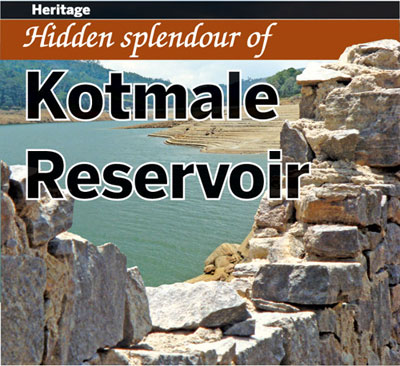
The Kotmale Reservoir which is nestled in the central highlands of the country between hills is indeed a breathtaking view. When watching its cool, clear waters ripple in the gentle breeze which blows across the vast expanse of water, no one would believe that there are many more things to feast one's eyes on, beneath the tranquil waters. Submerged by the waters of the reservoir are the ruins of many temples and human settlements. In fact, more than 14 tea estates, 57
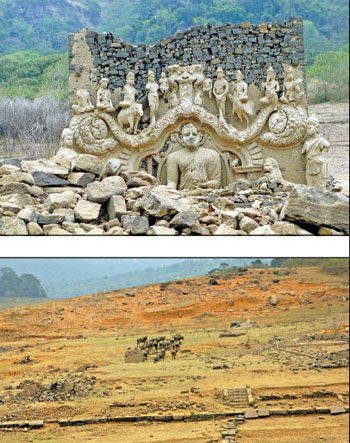
villages and about 54 ancient temples, among others are said to have gone under water when the reservoir was built. While many of these places do not exist at present, even underwater, some of them still do. Among these, the ruins of the Kadadora Vihara are spectacular, especially the sculptured statues of the Buddha and other deities. However, they are a rare sight and can only be viewed according to the whims of the weather gods.
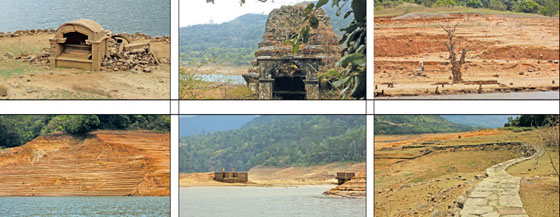
Lying silently under the water, perhaps for years, these ruins which are a nostalgic reminder of the past life in that area, make their appearance only during a severe drought. So, when the scorching Sun has appeased his thirst by drinking up most of the waters of the reservoir, the remains of the human settlements and the ruins of the temples that once saw thousands of devotees walk its floors and pay homage at its altars, slowly emerge, mesmerising those who come to see them. In a severe drought, the bed of the reservoir sometimes becomes bone dry, with the earth cracking up to create a striking design on the ground. Perhaps, some of the villagers whose homes went under water to give birth to the Kotmale dam, reservoir, tunnel and underground hydro-electricity power station, then walk on the reservoir bed, reminiscing the days gone by.
Spread across a land area of 2,270 ha, the Kotmale Reservoir which embraces lands from both the Kandy and Nuwara Eliya districts, is nestled between the Tispane and Kadadora hills.
The Kotmale Reservoir project was one of the five major projects proposed under the Accelerated Mahaweli Development Programme, (AMDP) the country's largest ever hydro power scheme undertaken in ancient and modern times. Even though preliminary studies were first carried out for the Kotmale project way back in 1961, and again from 1964 to 1968 by the government with foreign assistance, the project did not get off the ground.
Then again another feasibility study was carried out with Indian assistance from 1973 - 1976. Thereafter, taking into account all the proposals from all these studies, the green light was given to commence work in February 1979 under the AMDP. The Kotmale reservoir was to be built, damming the Kotmale Oya which is one of the main tributaries of the Mahaweli River. The harvesting of the Mahaweli waters was carried out with the main aim of generating hydro electrical power to boost the national grid. And by damming the Kotmale Oya at an elevation of 2,100 feet above sea level, the reservoir which regulates a volume of 174 million cubic metres of water, at full capacity, was formed. The dam was constructed with three sluice gates which are opened to discharge the extra waters when the reservoir is at spill level. The crest length of the dam is about 520 metres and the height is about 87 metres.
The picturesque Kotmale Reservoir was impounded way back in November 1984 and power generation at the hydro-electrical power station commenced in June 1985. The electricity generated is 206 megawatts.
In order to compensate for the number of temples that were submerged by the waters of the Kotmale Oya impounded for the reservoir, the authorities laid the foundation stone for the construction of a magnificent bubble shaped stupa which was second only to the famous Ruwanveli Maha Seya of Anuradhapura on the right bank of the Kotmale dam facing the reservoir. The Mahaweli Seya also which is a towering 289 feet in hight, is built at an elevation of 950m (4,150ft) above sea level. The base of this great seya is 600 metres. Featured here are some of the spectacular ruins of Kadadora Vihara which are visible only during the drought season, the Seya and scenic views of the reservoir.
More on Kotmale and other reservoirs later.
************
Fact file
* The Kotmale project is one of five major head works projects undertaken under the Accelerated Mahaweli Ganga scheme.
* The Kotmale Oya flows through the rural up-country of Sri Lanka passing ancient villages steeped in history and tea plantations of a more recent era.
* The rock fill dam created a reservoir having an effective storage capacity of about 174 m. cm. (141,000 acre feet) enabling regulation of a large proportion of the recorded mean annual flow of the Kotamale oya at the dam site.
* The water impounded by the reservoir is conveyed through an underground water conductor system to an underground power station located at about 7.2 km. (4.5 miles) from the dam for generation of electric power. After power generation, is discharged through the outfall into the Mahaweli Ganga at the Atabage Oya confluence.
* About 3000 families lost their homes and lands due to the construction of the reservoir.
* The catchment area of the river at the dam site is 730 sq.miles.
*The drainage area of the reservoir is situated in the central hills ranging up to about 8,000 ft.
*The Dam Crest Length is 520 m and the dam height 87m.
* The Mahaweli Maha Seya is built on the right bank hill above the dam site at an elevation of 950 m (4150 ft.) above MSL ie. It overlooks the dam site from a place 257m (845 ft.) above. It consists of a 200 ft. (61,0 m) diameter and 11inch thick reinforced concrete shell, which supports a square chamber (31 ft.)a Dewatha Kotuwa (12 ft), a pinnacle 44(ft) and a Kothderella (52 ft) respectively. The overall height of the structure is 274 ft. (83ft )


https://www.sundaytimes.lk/160320/plus/a-dream-come-true-187190.html#:~:text=A%20DREAM%20COME,Hon.%20Gamini%20Dissanayake.
A DREAM COME TRUE
View(s):The 74th birth anniversary of the late Hon Gamini Dissanayake, the former minister in charge of the implementation of the great Mahaweli irrigation system falls on 20th march 2016. Almost the entirety of the great Mahaweli irrigation and hydropower generation scheme as dreamed by him has being completed successfully. the last element in this scheme, the Moragahakanda project too has commenced and this great son of Sri Lanka on whose shoulders dell the mantle of accomplishing one of the great irrigation schemes worthy of our nations illustrious past, can now rest in peace knowing that his primary mission was well accomplished.
However a secondary mission which was very dear to him and which commenced parallel to the Mahawei scheme was not accomplished during his lifetime, and even many years after his untimely demise. I am referring to the great Buddhist monument he had planned to be completed alongside the Mahaweli scheme, and international Buddhist centre located overlooking the first great reservoir of the Mahaveli scheme at Kotmale, with a Maga Stupa of the size comparable to the Maha Stupas built by the ancients in Anuradhapura, as its central edifice. This is a project that had been envisaged by him after the successful completion of the second stage the Meethirigala Vippassana meditation centre and the golden around the “Ashtapala” bodhi tree at Kataragama. This project referred to as the “Mahaweli Maha Seya”, based on the advice of the Ven. Elle Gunawansa Thero to replace several religious monuments inundated by the new Mahaweli reservoirs.
The project was inaugurated on the 20th march 1983, and was to be located on an escarpment in a village area known as “ Kotagapitiya” at Kotmale, overlooking the dam, not too far from the place where king Dutugamunu took refuge after being ostracized by his father. Hon Gamani Dissanayake also carefully chose the architect of the project, the former director general of the architect Dharmasiriwardene, and for engineering advice he chose the father of modern civil engineering inSri Lanka, Vidaya Jyothi Dr. A.S Kulasinghe. His design concept for the central edifice of the proposed religious centre was a hollow mega Stupa cover of a classical shape to encompass a central votive solid Stupa as in ancient Vata dagaba concept. He proposed the use of state of art construction techniques and materials of the late twentieth century for the central edifice.
A thin reinforced concrete shell dome structure, resting on end bearing cast in situ concrete pile foundations, with the rest of the classical superstructure made out of steel box beam structural elements covered by stainless steel plates, a pinnacle cast out of brass topped with the classical gem stone “Chuda manikaya” for the outer Stupa and 1\4 scale size model of the outer Stupa as the votive inner stupa where the relics were to be enshrined. The size of the outer Stupa was to be marginally smaller than the great Mahastupa Ruwanweliseya atAnuradhapura. The initial design and construction works of this pioneering construction was carried out by a selected engineering staff from the central engineering consultancy bureau. Some special construction equipment was provided by the state engineering corporation and some construction materials by the main contractor of the Kothmale dam, Skansa. The cost effective methodologies adopted for the construction, especially the 11 inch think, 200 foot diameter dome bears the stamp of the genius of Dr. kulasinghe.
The untiring superhuman efforts of the CECB engineers and technicians and the proper leadership and guidance given by the Hon. Gamini Dissanayake, who was always at hand to check and assist in the progress of his dream, led to a trouble free construction progress paralleling that the adjacent dam. Unfortunately the work on this project cam to the stand still in 1990 with him leaving Mahaweli ministry.
However work on the foundations shell dome, dome patina cover, and the some works on the steel super structure considered as a major portion of the outer Stupa works had been completed by then. It took almost 10 years to recommence work on this project as a result of an appeal made by Mrs. Srima Dissanayake and some religious dignitaries of the area among others, to the president of the republic to assist in completing this Stupa which when completed would be comparable tin size to the great Stupas of Anuradhapura constructed thousands of years ago. On the direction of the president madam chandrika Kumarathinga, Mahaweli ministry under Hon Maithripala Sirisena graciously consented to assist in recommencement of works. A committee was formed under the chairmanship of Vidhya Jyothu Dr A.N.S Kulasinghe consisting of eminent engineers and architects who previously worked on this project from CECB, SEC etc. initial funds were given from a fund earmarked by Hon. Gamini Dissanayake for the balance works of this project. Work recommended on a low key and progressed gradually according to availability of funds.
The balance works of the superstructure consisting mainly of the Haterskotuwa, Dewatakotuwa Kothkrella made entirely out of stainless steel was completed and the 13 feet high brass kotha in 12 sections was locally manufactured and placed on the structure by the beginning of 2008. Minor work on the superstructure continued until 2010 when funds available were totally exhausted. The outer Stupa in its full glory, few feet shorter than the Ruwanwely Seya, could now be proudly seen by the people pf the area. However the votive inner Stupa with the enshrined relics was yet to be built to bring this Stupa up to a place worthy of veneration although a Bodhi tree sapling from Maha Bodhi had been planted in a Bodhigaraya in the premises of the proposed centre.
At the very inception of the Mahaweli project, the intention of late Hon.Gamini Dissanayake was to construct a Maha Seya (holy temple) in remembrance of all religious places that slept under the waters of giant Mahaweli reservoirs. For that purpose, the Mahaweli Maha Seya project was initiated. Though late Hon. Gamini Dissanayake could not complete this project, today his elder son, Hon minister Navin Dissanayake, has taken steps to complete this project. His sole intention is to complete the Mahaweli Maha Seya construction at the earliest and hand it over to the people as a place of worship.
It has been decided to place the sacred Jewel on the finial of “Mahaweli Maha Seya”. And it becomes a day to remember because this memorable occasion takes place on the 74th birth anniversary of the late Hon. Gamini Dissanayake.


Comments
Post a Comment